PROJECT OVERVIEW:
X needed a new mobile app for women that would enhance their current fitness and wellness routines.
The problem:
To uncover what would enhance a woman’s current mobile app experience and why.
By taking a human-centric approach in my research, I found what our users really struggled with were apps that weren’t flexible enough to accomadate their long-term journeys, where their goals and needs often changed. What they really wanted was a mobile app that continusouly reflected their current routines, regardless of what activity or goal they are aspiring towards.
A user-centric solution:
In synthesizing my research, I created a thoughtful app for women with existing f/w routines that is a concise and customizable tool for measuring and organizing their progress across any activity, making them feel confident, inspired, and in control of their unique journey.
ROLE:
Solo Project, Research & Product Designer
DATE:
Sept 9-21, 2024
TECHNOLOGY:
Figma
Zoom
METHODS:
1 ﹒ Directed Storytelling
2﹒ Affinity Mapping
3﹒ Think Aloud Testing
RESEARCH:
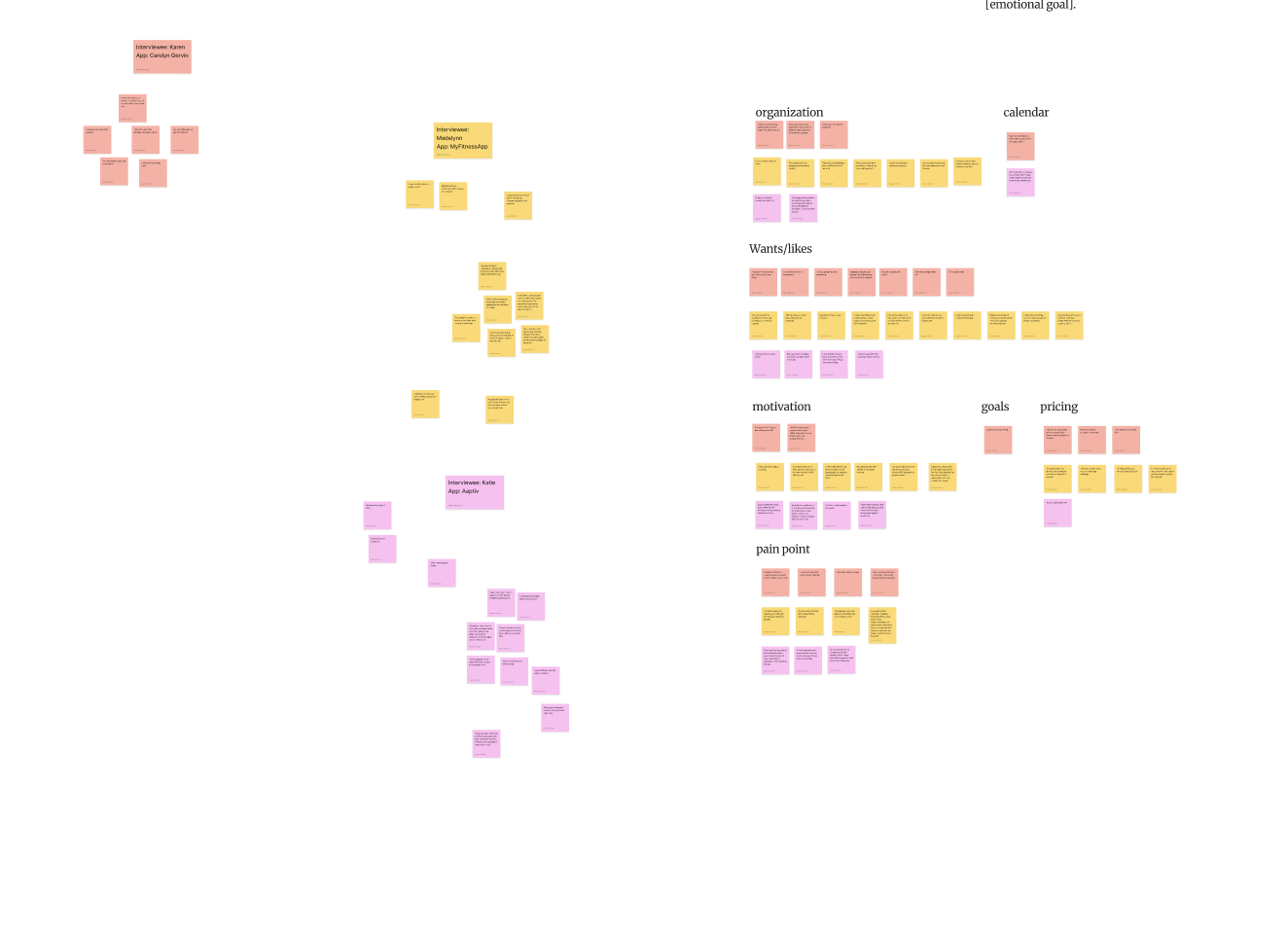
Directed Storytelling + Affinity Mapping:
There is no one single activity women have to reach their goals.
One woman might be an active marathon runner preparing for her third race. Another might be a powerlifter who struggles to eat enough protein. Another might be focused on starting a new diet but doesn’t want to lose some of her favorite recipes.
Realizing each woman is complex and on her own unique path was vital in the early stages of research. Because of this, I chose to use Directed Storytelling as my method for understanding users on a deeper level.
Key Insight:
Users liked their current apps for different reasons.
Sarah:
A 58 year old woman who has a weight lifting routine at home and loves the personality of her mobile app trainer
Jadeyn:
A 30 year old woman who is training for her first marathon and has been using the same fitness app for 8 years. She loves it because it provides playlists in a unique way that she uses during her long runs when she is bored of her current music.
Marley:
A 26 year old woman who is focused on losing weight while also trying a new food routine due to a recent diagnosis of PCOS. She loves her app because she can choose what it looks like and how it tracks her food intake.
But they disliked their current apps for the same reasons.
One grievance they all shared: calendars
Sarah:
”I know a lot of people use their calendar that you can pay, but I keep my own instead.”
Jadeyn:
“I like to be able to visualize my calendar and the app doesn’t really do it as well as my other calendar app.”
Marley:
“They have a calendar but I use a different app for it because I like a 4-day view and there’s is the standard 7-day.”
SOLUTION:
Synthesis:
Three very different goals, and yet they all shared 3 common pain points.
The calendar option in the app isn’t how they organize their routine, so they use a separate app for it
The app keeps adding more and more content that isn’t relevant to their need, making it harder to enjoy the app and feeling like it isn’t for them or that they’re paying too much for stuff they don’t use
They go months without using it not because they don’t love the app, but because their f/w routine changes. They take breaks from their activities, they try something new, they give up for a little bit, they come back.
With this insight, I was able to pinpoint the need of our users and develop a plan for prototyping.
The Plan:
To create an app for women with existing health routines who want a concise and customizable way of measuring their progress so that they can feel confident, inspired, and in control of their unique fitness journeys.
THE PROTOTYPE:
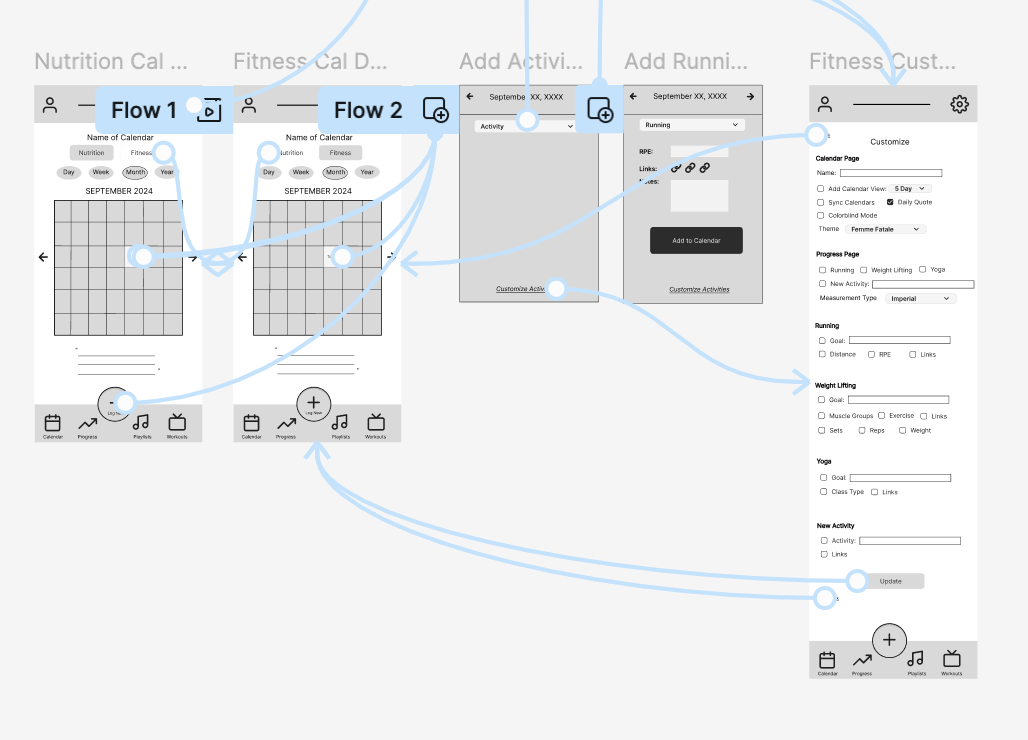
Wireframes and prototype created in Figma
USABILITY TESTING:
In order to make sure we were keeping our focus on the end user, I conducted a usability test using the Think Aloud research method with three participants.
Goals:
Understand how well our prototype is accurately comprehended
Understand how easily a user can organize their f/w routine in a way that’s customized to their unique fitness journey.
We Asked:
Imagine you’re a marathon runner. Can you show me how you might log a run and customize it to track just your distance?
Findings & Next Steps:
There were multiple findings in the usability test of things that could be enhanced. Combining them into three specific changes, the next version will focus on:
Priority 1:
Restructuring and breaking up the customization page into smaller, more digestible pages that can be found with affordances to signal the type of customization users should expect.
Priority 2:
Adding visibility, guidance, and encouragement to different functionality and actions you can take within the app by adding in communication + welcome pages for new users
Priority 3:
Adding more signals that encourage the use of the nutrition portion of the app.
PROJECT TAKEAWAYS:
Cleaned up prototypes - a few sections of the prototype needed to be removed before usability tests and it confused interviewees
Finding the balance between open-ended questions and providing guidance for the interviewee
To wait until I have all of the information before synthesizing.
It was hard not to get excited when I started hearing specific themes come up. However, I realized pretty quickly that starting to tug on patterns too early would muddle the interview experience.
Prototype V2 coming soon
⟶
View Project 2